
Soups & Stews
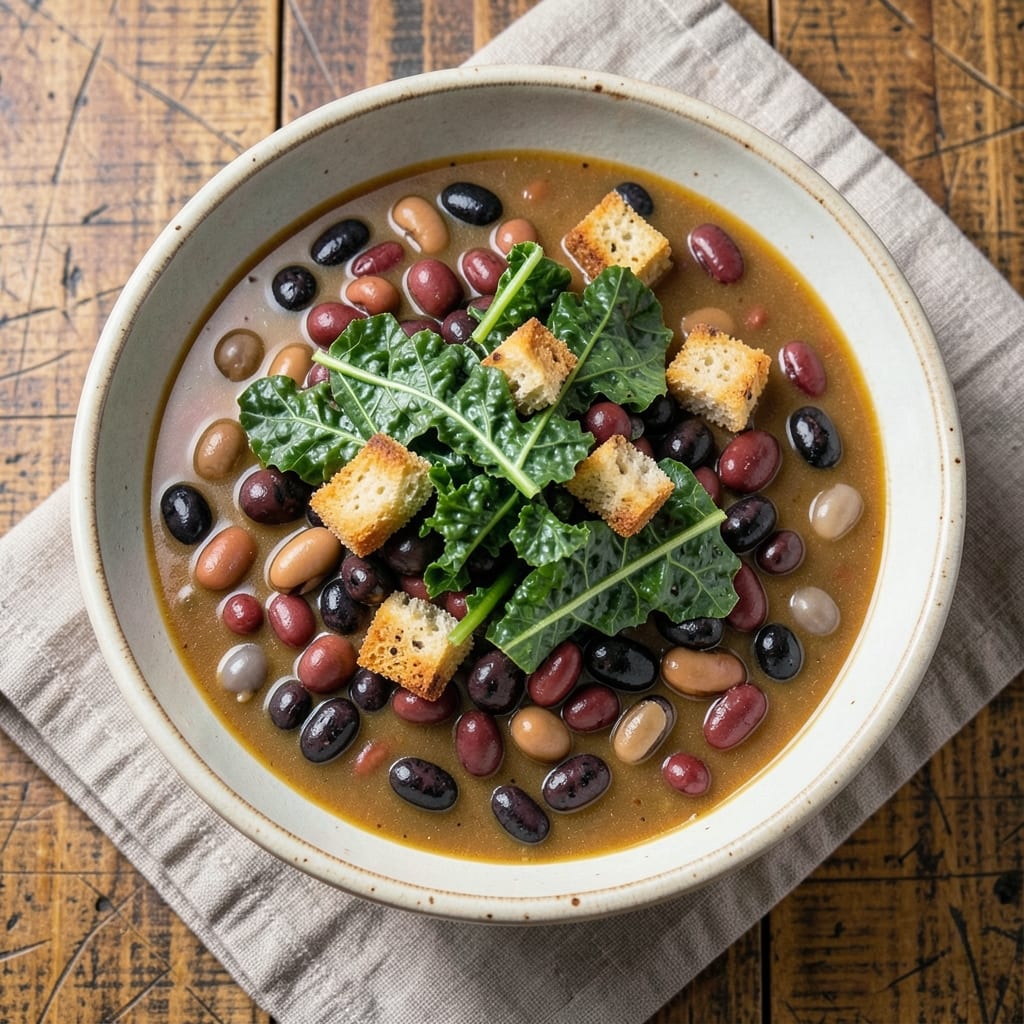
This 15 bean soup recipe with kale transforms humble pantry staples into a hearty, nutrient-packed meal that tastes like a hug in a bowl. 💛 I first made this during a particularly chilly winter when I needed something substantial yet simple—no fancy ingredients, just good, wholesome comfort. The secret lies in balancing earthy beans with the peppery brightness of kale, all simmered together until flavors meld into perfect harmony.
The beauty of this recipe is its versatility—it's equally at home on a busy weeknight or as the centerpiece of a Sunday gathering. We start with a rich vegetable broth infused with aromatic vegetables and spices, then add a medley of beans (navy, kidney, pinto) that soak up all the flavor. The kale comes in late to maintain its vibrant texture, adding a satisfying bite that contrasts beautifully with the tender beans.
What you'll end up with is a soup so deeply satisfying it disappears faster than you can say "second bowl." The beans become tender yet hold their shape, while the kale wilts just enough to soften its edges without losing its characteristic peppery punch. The broth reduces to a perfect consistency—rich enough to coat a spoon, but light enough to let each ingredient shine.
Serve it with crusty bread to soak up every last drop of that flavorful broth, or pair it with a simple green salad for balance. This is the kind of soup that tastes even better the next day, making it perfect for meal prep. Let's get cooking—your taste buds (and leftovers) will thank you.
Ingredients for 15 bean soup recipe with kale
Here’s what you’ll need to create this comforting, wholesome 15 bean soup with kale—simple staples that pack big flavor.
| Ingredient | Amount | Notes |
|---|---|---|
| Vegetable Broth 💧 | 6 cups | Low-sodium preferred, homemade or quality store-bought |
| Navy Beans 🌾 | 1 cup | Dried, soaked overnight |
| Kidney Beans 🌾 | 1 cup | Dried, soaked overnight |
| Pinto Beans 🌾 | 1 cup | Dried, soaked overnight |
| Black Beans 🌾 | ½ cup | Dried, soaked overnight |
| Great Northern Beans 🌾 | ½ cup | Dried, soaked overnight |
| Lima Beans 🌾 | ½ cup | Dried, soaked overnight |
| Garbanzo Beans 🌾 | ½ cup | Dried, soaked overnight |
| Cranberry Beans 🌾 | ½ cup | Dried, soaked overnight |
| Cannellini Beans 🌾 | ½ cup | Dried, soaked overnight |
| Kale 🥬 | 4 cups | Chopped, stems removed |
| Onion 🧅 | 1 whole | Yellow or red, diced |
| Carrot 🥕 | 2 whole | Medium, diced |
| Celery Stalks 🥬 | 3 whole | Diced, for broth base |
| Garlic Cloves 🧄 | 4 cloves | Minced, for depth of flavor |
| Tomato Paste 🍅 | 2 tbsp | For richness and color |
| Bay Leaves 🌿 | 2 whole | For aromatic depth |
| Thyme 🍃 | 1 tsp | Dried, or 1 tbsp fresh |
| Salt 🧂 | 1 ½ tsp | Adjust to taste |
| Black Pepper 🌶️ | ½ tsp | Freshly ground |
| Olive Oil 🫒 | 2 tbsp | For sautéing vegetables |
The beans are the heart of this soup, so don’t skimp on variety—each type brings its own texture and flavor. Bulk bins at stores like Trader Joe’s or Whole Foods are perfect for finding dried beans at affordable prices. If you’re short on time, canned beans work in a pinch (just drain and rinse), but soaked dried beans give that unmatched depth of flavor. Look for beans that are plump and firm—anything shriveled or discolored should be avoided. For the kale, curly green kale is ideal, but any leafy green will do. Store dried beans in a cool, dark place for up to 1 year, and fresh kale in a plastic bag in the fridge for 5-7 days.
No dried beans? Canned beans are a great shortcut—just make sure to rinse them well to remove excess sodium. Short on kale? Spinach or Swiss chard works beautifully, though the flavor will be milder. The vegetable broth can be homemade (simmer veggie scraps with herbs) or store-bought—Pacific Foods or Imagine brands are my go-tos for low-sodium options. If you’re feeling adventurous, swap half the beans for lentils or chickpeas for a different texture. The tomato paste adds richness, but if you’re avoiding it, a splash of balsamic vinegar gives a similar tang.
This soup tastes even better the next day, so make extra and freeze portions for quick meals later. Store leftovers in the fridge for up to 5 days—the flavors meld beautifully over time. For freezing, portion into airtight containers and thaw overnight in the fridge. The kale wilts down significantly, so don’t worry if it looks like too much at first. Serve with crusty bread or a sprinkle of freshly grated Parmesan if you’re not keeping it strictly vegetarian.
Why You'll Love This Recipe
- No-Chop Nightmare: I swear by this—just toss in the beans (no soaking!) and let the broth do the work while I stir in kale at the end. The only prep is rinsing the beans and chopping the kale, which takes less time than arguing with a picky eater about dinner.
- Earthy Umami Bomb: That mix of navy, kidney, pinto, and black beans? It’s like a flavor party in your bowl. The kale adds a peppery bite, but the broth—especially if you use homemade with carrot tops—turns this into a rich, satisfying hug in soup form.
- Lunchbox Hero: Between us, this is my go-to for meal prep. I make a big batch on Sundays, and by Wednesday, I’m still eating it cold with crusty bread. The beans hold up perfectly, and the kale stays vibrant longer than you’d expect.
- Pantry Magic: Honestly, if you’ve got a can of beans and a pot, you’re covered. I’ve made this with whatever beans I had (even lentils in a pinch), and it’s still ridiculous good. Plus, the leftovers? Freeze half for those days when you’d rather microwave than cook.
Step-by-step instructions for 15 bean soup with kale
This hearty soup comes together in one pot for maximum flavor and minimum cleanup!
🍳 Step 1: Sauté the Vegetable Base
Heat the 2 tablespoons olive oil in a large Dutch oven or heavy pot over medium heat. Add the diced 1 whole onion, 2 whole carrot, and 3 whole celery stalks, stirring occasionally for 5-6 minutes until the vegetables soften and the onion becomes translucent.
Here's where the magic starts—you'll smell that sweet, caramelized aroma developing. Add the 4 cloves garlic cloves and 2 tablespoons tomato paste, stirring for another 1 minute until fragrant. This aromatic base will carry through the entire soup, giving it depth and richness.
🍳 Step 2: Build the Flavor Foundation
Pour in the 6 cups vegetable broth and bring to a gentle boil. Stir in the 1.5 teaspoons salt, 0.5 teaspoon black pepper, 1 teaspoon thyme, and 2 whole bay leaves. Add all the drained beans—1 cup navy beans, 1 cup kidney beans, 1 cup pinto beans, 0.5 cup black beans, 0.5 cup great northern beans, 0.5 cup lima beans, 0.5 cup garbanzo beans, 0.5 cup cranberry beans, and 0.5 cup cannellini beans—and bring to a rolling boil.
Once boiling, reduce heat to low-medium and let it simmer uncovered for 30 minutes. You'll notice the beans start absorbing the broth and the soup begins to thicken slightly. This simmering time is crucial—it allows the beans to soften while keeping them intact rather than mushy.
🥘 Step 3: Add Kale and Finish Cooking
After the 30-minute simmer, stir in the 4 cups chopped kale. The kale will wilt dramatically as it cooks, releasing its earthy flavor into the soup. Let the soup simmer uncovered for another 20-25 minutes until the beans are tender but still hold their shape.
Here's the thing—you want the beans to be fork-tender but not falling apart. If you're using dried beans, they'll need this full cooking time. If you're using canned beans (not mentioned here, but just in case), you'd reduce this time by 15-20 minutes. The kale should be completely wilted with no visible stems remaining.
⏰ Step 4: Season and Rest
Remove the 2 whole bay leaves and taste the soup. Adjust seasoning with additional salt or black pepper as needed—this is where you can really personalize the flavor. I like to add a splash of lemon juice or a pinch of red pepper flakes for brightness, but that's optional.
Let the soup sit off heat for 10 minutes before serving. This resting period allows the flavors to meld together perfectly. The soup will thicken slightly as it cools, creating that perfect hearty consistency we're after. Serve warm with crusty bread to soak up every last drop!
Pro Tips For Making 15 Bean Soup Recipe With Kale
- SOAK BEANS OVERNIGHT: I learned this the hard way—rushing beans with a quick soak means the soup stays grainy and undercooked. Navy and pinto beans especially need 8+ hours in water to soften properly; kidney and black beans can handle 4, but don’t skip it. Use a big bowl and cover with an inch of water above them—no measuring cups needed.
- SIMMER LOW AND SLOW: This isn’t the time to boil vigorously. After the beans hit a soft texture (about 45 minutes), drop the heat to a bare simmer—just small, occasional bubbles. Too much heat turns beans mushy and makes the broth cloudy. I used to rush it, and the texture suffered every time.
- SALT THE BROTH LAST: Adding salt early toughens the beans and makes them absorb too much water. Wait until the beans are tender and the kale is added, then season the broth properly. Taste and adjust—this soup needs bold flavor, but you’ll ruin the beans if you salt them too soon.
- WILT KALE IN BATCHES: Tossing raw kale into the pot at the end just makes it float like a sad, limp raft. Instead, blanch small handfuls in a separate pot for 30 seconds, then shock in ice water to stop cooking. This keeps the texture crisp and vibrant—no more chewing on rubbery leaves. (Yes, it’s extra work, but it’s worth it.)
Essential equipment for perfect results
Pot Essentials
You don’t need fancy equipment for this soup, but a few key tools make all the difference. A 6-8 quart Dutch oven is my go-to—it holds all the beans and broth while giving even heat distribution. I swear by the Le Creuset Signature for its durability and even cooking, though any heavy pot will work. If you’re short on space, a large stainless steel stockpot (like All-Clad) works too, just stir occasionally to prevent sticking. 💛
Bean Prep Tools
Soaking dried beans properly is half the battle. A large glass bowl (I use Pyrex) lets you see the beans while they soak, and a fine-mesh strainer (like OXO Good Grips) makes draining effortless. For chopping kale stems, a sharp chef’s knife and cutting board are non-negotiable—I recommend Victorinox Fibrox for its grip. A mandoline speeds up dicing carrots and celery if you’re prepping for a crowd.
Broth Boosters
Infusing flavor into your broth is where small tools make a big impact. A wooden spoon (like Ozeri Touch-Grip) prevents scratching your pot, while a microplane (I love Barbaglio) quickly minces garlic for maximum aromatic release. For homemade broth, a fine-mesh sieve (like HOMWE) strains out unwanted bits. If you’re using store-bought broth, a liquid measuring cup ensures you get the exact 6 cups needed.
Simmering Secrets
Low-and-slow simmering is key, so a digital thermometer (like Thermoworks Thermapen) helps monitor broth temperature—ideal range is 185-200°F. A ladle (I prefer OXO Good Grips) lets you taste-test as you go, while a slotted spoon removes bay leaves at the end. For stirring, a long-handled wooden spoon prevents burns when adjusting heat. Pro tip: A pot lid with a chimney (like Circulon) keeps steam in and condensation out during simmering.
Serving Up
Presentation matters! A large serving spoon (like Zwilling) ensures generous portions, while a fine-mesh strainer catches any stray kale stems before serving. For garnishes, a small bowl holds toppings like lemon wedges or red pepper flakes. If you’re prepping ahead, airtight glass containers (I use Le Parfait) keep leftovers fresh for up to 5 days in the fridge. A slow cooker (like Instant Pot) can also handle this recipe—just adjust cooking times to 4-5 hours on low.
Nutrition facts
Frequently asked questions
Can I substitute canned beans for dried beans in this recipe?
Yes, you can use canned beans to save time! Just rinse them thoroughly to remove excess sodium, and reduce the simmering time by 15-20 minutes since they're already pre-cooked. For best results, combine canned beans with some soaked dried beans to maintain texture variety in your soup.
How do I properly soak dried beans for this recipe?
Place dried beans in a large bowl and cover with plenty of water (about 3 cups per 1 cup of beans). Soak overnight (8-12 hours) or use the quick-soak method: boil beans for 2 minutes, then let them sit off heat for 1 hour covered with hot water. Always drain and rinse before using.
Can I make this soup in a slow cooker?
Follow the same steps but transfer everything to your slow cooker after sautéing the vegetables. Cook on low for 6-7 hours or high for 3-4 hours, adding kale during the last 30 minutes of cooking. The slow cooker's gentle heat helps beans soften evenly without breaking apart.
What if my kale is too bitter?
Bitter kale is normal—it's the plant's natural defense! To reduce bitterness, blanch the kale in boiling water for 30 seconds before adding it to the soup. Alternatively, add a pinch of sugar or a splash of apple cider vinegar to the soup while cooking to balance the flavors.
How can I make this soup more substantial for a crowd?
Double the recipe and add 1 cup cooked quinoa or brown rice per serving for extra heartiness. You could also stir in 1 cup diced potatoes during the initial simmering phase. For protein, consider adding 1 cup cooked lentils or 1 cup shredded rotisserie chicken at the end.