
Soups & Stews
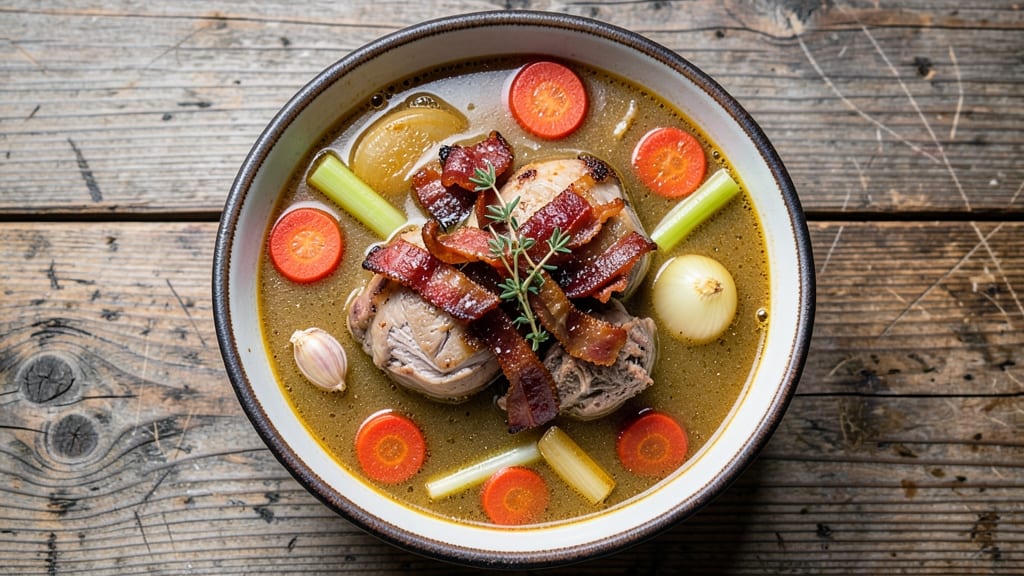
This bacon hock soup delivers the kind of slow-simmered richness that transforms humble ingredients into something extraordinary. The secret lies in hours of gentle simmering, where pork hocks break down into tender, flavorful chunks while releasing collagen that thickens the broth into a velvety, umami-packed elixir.
Every spoonful carries layers of savory depth that linger long after the last bite.
The process begins with browning the bacon and pork hocks for maximum flavor development, then building the broth with aromatic vegetables and herbs. As it simmers, the collagen dissolves, creating a naturally thickened soup that needs no starch.
The result is a dish that feels both rustic and refined—a perfect balance of hearty comfort and sophisticated technique.
What you'll end up with is a soup that's impossible to resist: tender pork hocks that practically melt in your mouth, crispy bacon bits floating on top, and a broth so rich it coats your spoon.
The umami crunch from the pork bones adds a satisfying texture that elevates this beyond ordinary soups. This is the kind of recipe that turns weeknight dinners into memorable meals.
Serve with crusty bread to soak up every last drop of that flavorful broth, or pair it with a simple green salad for balance. The beauty of this soup is its versatility—it's equally at home as a cozy weeknight dinner or a centerpiece for a gathering.
Let's get started on creating this slow-simmered masterpiece.
Ingredients for bacon hock soup
Pork hocks and thick-cut bacon form the soul of this rich, slow-simmered soup.
| Ingredient | Amount | Notes |
|---|---|---|
| Pork Hocks 🍖 | 2 lb | Fresh, not frozen for best flavor |
| Thick-Cut Bacon 🥓 | 1 lb | Thick-cut preferred for crispiness |
| Yellow Onion 🧅 | 2 whole | Medium-sized, peeled and quartered |
| Carrots 🥕 | 4 medium | Peeled and cut into 2-inch chunks |
| Celery Stalks 🧅 | 4 whole | Cut into 2-inch pieces |
| Garlic Cloves 🧄 | 6 cloves | Peeled and smashed |
| Bay Leaves 🌿 | 2 whole | Fresh preferred |
| Thyme Sprigs 🌿 | 4 whole | Fresh thyme stems removed |
| Black Peppercorns 🌶️ | 1 tbsp | Freshly cracked |
| Salt 🧂 | 2 tbsp | Kosher or sea salt |
| Water 💧 | 8 cups | Enough for slow simmering |
| Apple Cider Vinegar 🍎 | 1 tbsp | For brightness |
| Crusty Bread 🍞 | 1 loaf | For serving, optional |
The pork hocks are the heart of this soup—look for fresh, uncooked hocks at specialty butchers or well-stocked grocery stores like Whole Foods. They should be firm to the touch, with a rich pink color. If you can't find fresh, frozen works but thaw them overnight in the fridge. The bacon? Thick-cut is non-negotiable—it renders slowly, creating crispy edges while keeping the meat tender. I always buy mine from Costco or Trader Joe's for the best quality at a good price. The vegetables—carrots, celery, and onions—should be fresh but don't need to be organic; just make sure they're firm and free of blemishes.
No fresh thyme? Dried thyme works at one-third the amount, but fresh has a brighter flavor that stands up to the long simmer. Running out of bay leaves? Dried bay leaves are fine, but use half the quantity. The apple cider vinegar adds a subtle tang—white vinegar or lemon juice can substitute in a pinch. For the salt, kosher or sea salt is ideal, but table salt works if that's what you have. The black peppercorns should be freshly cracked for maximum aroma, but if you're in a hurry, pre-ground will do. The key is letting everything simmer low and slow—don't rush this part—the collagen needs time to break down into that velvety texture.
This soup tastes even better the next day as the flavors meld. Store leftovers in the fridge for up to 5 days—the broth will thicken further, becoming even more luxurious. For longer storage, freeze portions for up to 3 months. I like to portion it into individual containers so I can grab a single serving for lunch. The crusty bread is optional but highly recommended—a baguette or sourdough works perfectly. If you're short on time, even store-bought bread will do the trick.
Why You'll Love This Recipe
- One-Pot Magic: I swear by this—just toss everything into a single pot, walk away, and let the pork hocks and bacon do all the work. No chopping like a fine chef, no fancy techniques. The onions and celery practically melt into the broth while you’re still deciding what to watch on TV.
- Rich, Smoky Depth: That crispy bacon and slow-cooked pork hock? Pure flavor gold. The bacon adds this salty, smoky punch, while the pork hocks turn tender and fall apart—like a hug in a bowl. Honestly, the first time I tasted it, I nearly burned the kitchen.
- Weeknight Workhorse: Between us, this is my go-to when I’m too tired to think. Serve it over rice for dinner, pack it for lunch the next day, or even freeze half for when life gets chaotic. The flavors only get better after sitting overnight—trust the process.
- Budget-Friendly Feast: Pork hocks and thick-cut bacon stretch this recipe into a full meal without breaking the bank. I’ve fed four people for under $15, and everyone leaves happy. Leftovers? Even better—reheat with a splash of water, and it’s like you’re eating fresh again.
Step-by-step instructions for slow-simmered bacon hock soup
This method transforms tough pork hocks into melt-in-your-mouth tenderness with rich, smoky depth.
Render the Bacon and Build the Flavor Base
Cut the 1 lb thick-cut bacon into ½-inch pieces and place in a large Dutch oven over medium heat. Let it render undisturbed for 8-10 minutes until the fat is golden and crispy, stirring occasionally to prevent burning. The bacon should release about ½ cup of fat—this is your flavor foundation.
Once the bacon is crisp, remove it with a slotted spoon and set aside, leaving the rendered fat in the pot. Add the 2 whole yellow onion (quartered), 4 medium carrots (cut into 2-inch chunks), and 4 whole celery stalks (cut into 2-inch pieces) to the pot. Cook for 5 minutes, stirring occasionally, until the vegetables begin to soften and the onion becomes translucent. This step develops the soup's aromatic backbone.
Brown the Pork Hocks and Sear the Aromatics
Pat the 2 lb pork hocks dry with paper towels—this ensures a better sear. Working in batches if needed, sear the hocks in the Dutch oven over medium-high heat for 3-4 minutes per side until deeply browned. The Maillard reaction here creates that deep umami flavor you crave in a rich soup.
After browning, remove the hocks and set them aside. In the same pot, add the 6 peeled garlic cloves (smashed) and cook for 30 seconds until fragrant. Immediately add the 2 whole bay leaves, 4 whole thyme sprigs, 1 tbsp freshly cracked black peppercorns, and 2 tbsp salt. Stir for 10 seconds to coat the vegetables in the spices, then pour in the 8 cups water and 1 tbsp apple cider vinegar. Scrape up any browned bits from the bottom of the pot—they're packed with flavor.
Simmer the Soup Low and Slow
Return the pork hocks and reserved bacon to the pot. Bring to a gentle boil over high heat, then immediately reduce to a low simmer (small bubbles at the edges). Cover partially and cook for 2-2.5 hours, skimming off any foam or impurities that rise to the surface with a ladle. This slow cook transforms the tough connective tissue into gelatinous richness.
After 2 hours, check for doneness by inserting a sharp knife into the thickest part of a hock—it should slide in easily with minimal resistance. If the hocks aren't tender yet, continue simmering for another 30 minutes. The soup should reduce slightly, intensifying its flavor as it cooks. The aroma should be rich, smoky, and deeply savory—this is your cue that the collagen is breaking down.
Finish and Serve with Crispy Bread
Once the pork hocks are fork-tender, remove them from the pot and let them rest on a cutting board for 5 minutes. Strain the broth through a fine-mesh sieve into a clean pot, pressing gently on the vegetables to extract maximum flavor. Discard the solids or compost them. Return the strained broth to the pot and bring it back to a gentle simmer over medium-low heat. Skim off any remaining fat if desired.
Shred the pork hocks with two forks, discarding any large bones or gristle, and return the meat to the pot. Adjust the seasoning with additional salt or pepper if needed. Ladle the soup into bowls, garnishing each serving with a few crispy bacon pieces and a slice of crusty bread for dipping. The contrast of the tender hock meat against the crisp bread makes every bite satisfying.
Pro Tips For Making Bacon Hock Soup
- BLANCH PORK HOCKS FIRST: Drop those pork hocks in boiling water for 5 minutes before braising—it loosens the collagen and cuts the cooking time by nearly half. I used to skip this, and my soup always tasted like it needed more time, even after hours of simmering.
- CRISP THE BACON LOW: Cook the thick-cut bacon at medium-low heat until the fat renders but the meat stays just shy of crispy—you want it tender enough to break apart later. After burning two batches, I learned: patience here means richer flavor without chewy bits.
- CHAR THE VEGETABLES: Sear the onions, carrots, and celery in the bacon fat until they’re deeply browned, not just softened. That caramelization builds depth—skip it, and your soup tastes like it’s missing something, even if everything else is perfect.
- SKIM THE SCUM EARLY: After the first 20 minutes of simmering, skim off the foam and impurities rising to the surface. Ignore this, and your soup will taste cloudy and off—no amount of seasoning fixes that later. (Yes, it’s gross, but worth it.)
Storing and reheating your bacon hock soup
Refrigerator Storage
Let your bacon hock soup cool to room temperature for no more than 2 hours before transferring to airtight containers—I use glass Pyrex with snap-on lids for best results. Store it in the fridge at 40°F or below for up to 5 days.
The flavors actually deepen overnight as the collagen continues to break down, creating an even richer texture. I like to portion it into 2-cup servings for easy reheating later. 💛
Freezer Storage
For longer storage, freeze your soup in quart-sized freezer bags or airtight containers, leaving 1 inch of headspace for expansion. I recommend using freezer-safe silicone molds for individual portions—they thaw faster and prevent freezer burn.
Label each container with the date and freeze for up to 3 months. The broth will thicken further when thawed, making it even more luxurious.
Stovetop Reheating
My preferred method is stovetop reheating because it preserves the best texture. Pour the soup into a heavy-bottomed pot and heat over medium-low heat for 10-15 minutes, stirring occasionally.
If it looks too thick, add ¼ cup water or broth to restore the original consistency. Taste and adjust seasoning—it often needs a pinch more salt after reheating. 🔥
Microwave Reheating
For quick lunches, microwave individual portions covered with a damp paper towel. Heat on 70% power for 2-3 minutes, stir, then continue in 30-second intervals until reaching 165°F.
Add a splash of water if needed to prevent drying. This method works best for single servings and is perfect when you're short on time.
Reviving Texture
If your reheated soup seems too thick, thin it with 1-2 tablespoons of hot water or broth while stirring. For extra richness, stir in 1 tablespoon of butter or bacon fat during reheating.
The key is patience—rushing reheating can break down the delicate collagen that makes this soup so special. Take your time, and you'll get results just as good as fresh.
Serving Leftovers
Leftovers make fantastic lunches or light dinners. Serve with crusty bread or buttery cornbread for dipping. Garnish with extra crispy bacon bits or a sprinkle of fresh parsley for freshness.
I often reheat a portion in the morning and enjoy it with a side of pickled vegetables for balance. The contrast of textures makes every bite satisfying. ✨
Nutrition facts
Frequently asked questions
Can I substitute pork hocks with other cuts of pork?
While pork hocks are ideal for their collagen-rich broth, you can use pork knuckles or pork shanks as alternatives. These cuts will create a similar rich, gelatinous texture when simmered long enough. Avoid leaner cuts like pork loin—they won't provide the same depth of flavor or thickness to the soup.
How do I know when the pork hocks are fully cooked?
The hocks are done when they're fork-tender and easily shred with minimal resistance. After 2 hours of simmering, insert a sharp knife into the thickest part—it should slide in smoothly. If not, continue cooking for another 30 minutes. The broth should also thicken noticeably as collagen breaks down.
Can I make this soup in a slow cooker instead of a Dutch oven?
Brown the bacon and pork hocks first in a skillet, then transfer everything to a 6-quart slow cooker with the vegetables, herbs, and liquid. Cook on low for 8-10 hours or high for 5-6 hours, skimming foam occasionally. The slow cooker method is even more hands-off and yields excellent results.
Why does my bacon hock soup smell amazing but taste bland?
This usually happens if the broth didn't simmer long enough for flavors to meld. The key is patience—2-2.5 hours of simmering is non-negotiable. If needed, add a splash of apple cider vinegar or Worcestershire sauce for brightness, or a pinch of smoked paprika for depth. Taste as you go and adjust seasoning gradually.
Can I add potatoes or other vegetables to this soup?
Yes! Add diced potatoes (½ lb) or green beans (1 cup) during the last 30 minutes of cooking to prevent mushiness. For heartier soups, try adding cabbage or turnips—they hold up well to long simmering. Just avoid delicate veggies like zucchini or spinach, which would turn to mush.