
Soups & Stews
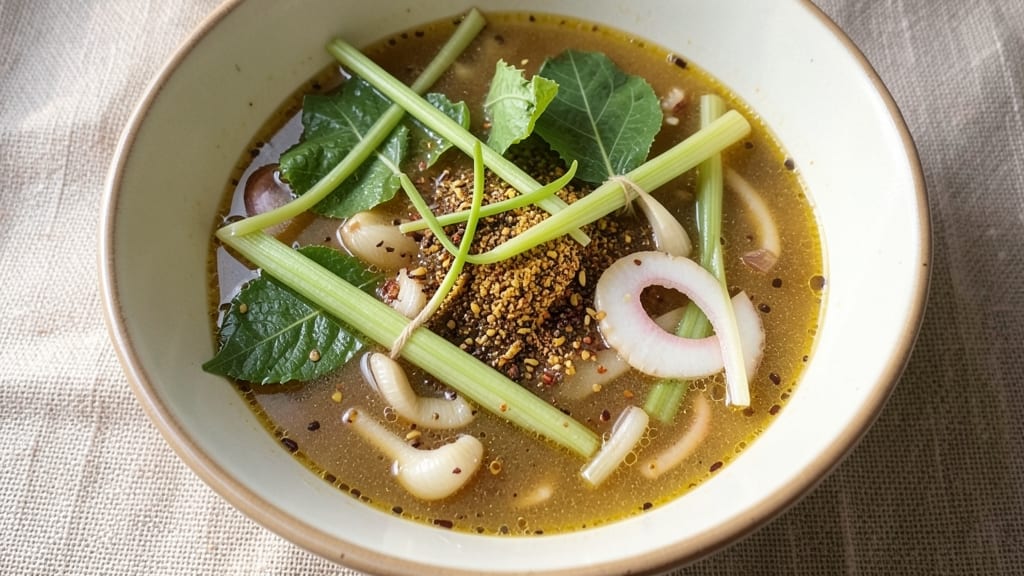
This Bangladeshi-style Thai soup recipe bridges two vibrant culinary worlds with a fragrant blend of lemongrass, coconut milk, and Bengali spices. The fusion begins with a rich broth infused with Thai lemongrass and galangal, then deepened by Bengali mustard oil and panch phoron—a five-spice blend that adds earthy warmth.
Every spoonful delivers layers of aromatic complexity that feel both familiar and excitingly new.
The secret to balancing these flavors lies in slow simmering—letting the spices meld while preserving their individual notes. We start with a fragrant base of ginger, garlic, and shallots, then build complexity with Thai herbs like kaffir lime leaves and lemongrass, all tempered by the creamy richness of coconut milk.
The result is a soup that's simultaneously comforting and invigorating, with just the right amount of heat from red chili flakes.
What makes this recipe special is how it transforms simple ingredients into something extraordinary. The broth develops a velvety texture from simmered coconut milk, while the spices create a fragrant aroma that fills your kitchen.
Each bite offers a harmonious dance of flavors—bright from the lime, creamy from the coconut, and spicy from the mustard oil—making it perfect for cozy evenings or sharing with friends.
For an extra touch of authenticity, finish with crisp fried shallots and fresh cilantro, which add texture and freshness. This soup isn't just a meal; it's an experience that brings the warmth of Bengali home cooking together with the vibrant energy of Thai flavors.
Let's create something truly special in your kitchen.
Ingredients for bangladeshi style thai soup
Fourteen ingredients that blend Thai and Bengali flavors into a fragrant, velvety soup experience.
| Ingredient | Amount | Notes |
|---|---|---|
| Fresh Lemongrass Stalk 🌿 | 4 whole | Bruised and cut into 2-inch pieces |
| Galangal Slices 🌱 | 3 slices | Fresh, about 1-inch thick |
| Kaffir Lime Leaves 🍋 | 4 whole | Torn into quarters |
| Mustard Oil 🫒 | ½ cup | High-quality, cold-pressed |
| Panch Phoron Spice Blend 🌶️ | 1 tbsp | Traditional Bengali five-spice |
| Fresh Ginger 🧅 | ½ cup | Finely chopped, peeled |
| Garlic Cloves 🧄 | 6 cloves | Minced, peeled |
| Shallots 🧅 | 2 whole | Peeled and finely chopped |
| Red Chili Flakes 🔥 | 1 tbsp | Adjust for heat preference |
| Coconut Milk 🥥 | 1 ½ cups | Full-fat, canned preferred |
| Vegetable Broth 💧 | 4 cups | Homemade or quality store-bought |
| Fresh Cilantro 🌿 | ¼ cup | Chopped, for garnish |
| Shallots 🧅 | ½ cup | Thinly sliced, for frying |
| Salt 🧂 | 1 ½ tsp | Adjust to taste |
| Lime Juice 🍋 | 2 tbsp | Freshly squeezed |
The heart of this fusion lies in the spices and aromatics. Look for fresh galangal and kaffir lime leaves at Asian markets—they make all the difference. Whole Foods or local Indian grocery stores usually carry them. If you can't find galangal, extra ginger at double the amount works in a pinch. Mustard oil should be cold-pressed and smell nutty—avoid the refined versions. Panch phoron is non-negotiable for that earthy depth, but you can make your own with fenugreek, cumin, mustard seeds, fennel, and nigella. The lemongrass needs to be bruised (lightly smashed) to release its oils.
No kaffir lime leaves? Substitute lime zest plus extra lime juice—it won't be identical, but it adds brightness. Running short on coconut milk? Full-fat coconut cream plus extra broth keeps the richness. Fresh ginger and garlic are ideal, but powdered works at half the amount if needed. For the shallots, yellow or red onions work in a bind, though they'll change the subtle sweetness. The red chili flakes can be swapped for fresh Thai chilies or cayenne, but adjust the quantity—they pack different heat levels. Always taste as you go; the broth should be fragrant but not overpowering.
This soup tastes even better the next day as flavors meld. Store in an airtight container in the fridge for up to 5 days, or freeze for 3 months—the coconut milk separates when frozen, so stir well before reheating. For the fried shallots, keep them in a sealed container with a paper towel to absorb oil—they stay crisp for 1 week. Make a double batch; the broth freezes beautifully for quick meals. The cilantro wilts fast, so store it separately and add it fresh when serving.
Why You'll Love This Recipe
- No-Chop Nightmare: I swear by this soup because the prep is actually minimal—just bruise the lemongrass and slice the galangal (no dicing, no mincing). The kaffir lime leaves go in whole, and boom, you’re done. Honestly, my lazy nights thank me every time.
- Mustard Oil Magic: That first hit of mustard oil—sharp, nutty, alive—transforms everything. It’s not just flavor; it’s the soul of the dish. Panch phoron ties it all together with a warmth that lingers, making each spoonful feel like a little celebration.
- Weeknight to Party: Same soup, endless uses. Toss in shrimp for a fancy dinner, keep it veggie for a quick lunch, or serve it cold with rice as a refreshing summer dish. My roommates still ask for it after months—because it works for everything.
- Leftovers That Lie: Between us, this soup only gets better the next day. The galangal and lemongrass mellow into the broth, deepening the taste without extra effort. I make a double batch on Sundays and eat it for three days—no one ever notices (or cares) that I’m reusing it.
Step-by-step instructions for bangladeshi-style Thai soup
This fusion soup delivers bold flavors through precise layering of aromatic bases and careful balance.
Prepare the Aromatic Base
Heat the 0.5 cup mustard oil in a heavy-bottomed pot over medium-low heat. Add the 2 whole shallots (finely chopped) and cook for 3-4 minutes until they soften and release their sweet aroma. This is your flavor foundation.
Add the 4 whole lemongrass stalks (bruised and cut into 2-inch pieces), 3 slices galangal, and 4 whole kaffir lime leaves (torn into quarters). Stir gently for 1 minute to allow the oils to infuse into these aromatic ingredients. You'll notice the pot filling with steam and the lemongrass releasing its citrusy fragrance.
Next, add the 0.5 cup fresh ginger (finely chopped), 6 cloves garlic cloves (minced), and 1 tbsp panch phoron spice blend. Cook for 2-3 minutes until the raw garlic smell disappears and the spices begin to sizzle. This step develops the complex flavor profile that defines this fusion soup.
Build the Spiced Broth
Pour in the 4 cups vegetable broth and bring to a gentle simmer. Add the 1 tbsp red chili flakes and 1.5 tsp salt, stirring to combine. Let the broth simmer uncovered for 10 minutes to allow the flavors to meld and deepen. The broth should reduce slightly and develop a rich, aromatic quality.
Here's the thing—don't rush this step. The longer the broth simmers, the more complex the flavors become. You'll know it's ready when the broth smells intensely of lemongrass, ginger, and the subtle heat of the chili flakes. Skim off any foam that rises to the surface for a cleaner final product.
Strain the broth through a fine-mesh sieve into a clean pot, pressing gently on the aromatics to extract maximum flavor. Discard the solids. This step ensures your soup will be smooth and free of any fibrous textures while retaining all the aromatic essence.
Create the Coconut Milk Base
In a separate saucepan, warm the 1.5 cups coconut milk over low heat until it reaches 160°F. This gentle warming prevents the coconut milk from curdling later when combined with the broth. The coconut milk should be warm to the touch but not hot.
Gradually pour the warm coconut milk into the strained broth while whisking continuously. This gradual addition creates a silky emulsion rather than a separated sauce. The mixture should thicken slightly but remain pourable. If the soup appears too thick, thin it with 2-3 tablespoons of hot vegetable broth from your reserve.
Return the soup to medium-low heat and let it simmer gently for 5 minutes. This final simmer allows the coconut milk to fully incorporate and develop its creamy texture. The soup should now have a balanced consistency—rich from the coconut but still light enough to sip easily.
Finish and Garnish
Remove the soup from heat and stir in the 2 tbsp lime juice. The acidity brightens all the flavors, cutting through the richness of the coconut milk. Taste and adjust the seasoning with additional salt if needed—this is where you fine-tune the balance between spice, acidity, and saltiness.
Ladle the soup into serving bowls. For the final presentation, fry the 0.5 cup shallots (thinly sliced) in 1 tablespoon of mustard oil over medium heat until golden brown and crispy. This takes about 3-4 minutes. Spoon these crispy shallots over each serving of soup.
Garnish each bowl with 1 tablespoon of chopped fresh cilantro. The vibrant green not only looks beautiful but also adds a fresh, herbal note that complements the complex flavors. Serve immediately while the soup is hot and the aromatics are at their peak intensity.
Pro Tips For Making Bangladeshi Style Thai Soup
- CRUSH THE LEMONGRASS: Split the stalk lengthwise and pound it with the flat side of your knife—this releases the oils and aroma way better than chopping. I used to just slice it thin, and the soup always tasted flat until I tried this.
- TOAST THE PANCH PHORON: Bloom the spice blend in mustard oil over low heat for 30 seconds—just until it smells nutty, not burnt. After burning one batch (yes, I was distracted), I learned to keep the heat gentle and stir like my life depends on it.
- SKIP THE BOILING GALANGAL: Add galangal slices after the broth starts simmering, not before. I learned this the hard way—boiling it too long turns them bitter, and you end up with a soup that tastes like medicine.
- USE KAFFIR LIME LEAF TEAS: Tear the leaves into rough pieces and steep them in warm broth for 10 minutes before adding the rest—this extracts more flavor without making the soup look like confetti. (Yes, even if you’re impatient like me.)
Troubleshooting great bangladeshi style thai soup
Mustard Oil Smoking Issue
If your mustard oil starts smoking excessively when heating, you're likely using too high heat. Mustard oil has a low smoke point—keep it on medium-low heat at all times. If it smokes anyway, remove from heat immediately and let it cool slightly before continuing.
For extra safety, use a heavy-bottomed pot like a Lodge cast iron—it distributes heat evenly and prevents hot spots that cause smoking. 🌡️
Broth Too Thin or Watery
The broth may be too thin if you didn't simmer it long enough or if your coconut milk wasn't warmed properly. Simmer the broth uncovered for an additional 5-10 minutes to reduce it slightly.
If the coconut milk separated when added, warm it to 160°F in a separate pan first, then whisk it into the broth gradually. For extra thickness, mix 1 tbsp cornstarch with 2 tbsp cold water and stir it into the soup at the end. 🥄
Coconut Milk Curdling
Curdling happens when coconut milk is added too quickly to hot broth. Always warm the coconut milk separately to 160°F before mixing, and pour it in slowly while whisking continuously.
If it curdles anyway, strain the soup through a fine-mesh sieve to remove lumps, then whisk in 1 tbsp of cold water to restore creaminess. For prevention, use full-fat coconut milk—it's more stable than light versions. 🥥
Flavor Too Mild or Bland
If your soup lacks depth, the spices likely weren't toasted enough. For stronger flavor, dry-toast the panch phoron and red chili flakes in the mustard oil for 30 seconds before adding other ingredients. Also, let the broth simmer uncovered for 15 minutes instead of 10 to concentrate the aromatics.
A final boost? Add ½ tsp fish sauce (common in Thai cooking) or 1 tsp soy sauce for umami richness. 🌶️
Shallots Not Crispy Enough
For perfectly crispy fried shallots, slice them paper-thin (use a mandoline if possible) and fry in small batches on medium heat. Overcrowding lowers the oil temperature, making them soggy.
Use freshly sliced shallots—they crisp faster than pre-cut ones. Drain them on a paper towel-lined plate to remove excess oil immediately after frying. 🧅
Lime Juice Overpowering
If the lime juice tastes too sharp, reduce it to 1 tbsp instead of 2 tbsp and balance with a pinch of salt or ½ tsp sugar. For a smoother finish, whisk the lime juice into the soup after removing it from heat.
Alternatively, substitute with 1 tbsp rice vinegar for a milder tang. Always taste as you go—adjust gradually! 🍋
Nutrition facts
Frequently asked questions
What makes this soup different from regular Thai or Bengali soups?
This recipe blends authentic Thai aromatics like lemongrass and galangal with Bengali mustard oil and panch phoron spice blend. The fusion creates a unique balance of creamy coconut milk, earthy spices, and bright lime juice that's neither purely Thai nor Bengali but distinctly its own flavor experience.
Can I make this soup vegetarian?
Yes! Simply replace the vegetable broth with a rich mushroom or lentil broth. For extra umami, add 1 tbsp soy sauce or ½ tsp miso paste when building the broth. The recipe maintains all its flavor complexity while being completely plant-based.
How do I adjust the spice level? Start with the 1 tbsp red chili flakes as written for mild heat. For medium heat, increase to 1.5 tbsp, and for spicy, use 2 tbsp. If using fresh Thai chilies, start with 1-2 and adjust to taste.
What's the best way to store leftovers?
Store in an airtight container in the fridge for up to 5 days. The flavors actually improve overnight! For freezing, portion into containers and freeze for up to 3 months. Thaw in the fridge overnight—never at room temperature. The coconut milk may separate when frozen, so stir well before reheating.
Can I use this soup as a base for other dishes?
This flavorful broth works perfectly as a base for curries, stir-fries, or even noodle dishes. Simply simmer the strained broth with your protein or vegetables, then adjust seasoning. The rich coconut-mustard oil blend adds incredible depth to any dish.